
Best overall: a back-print zip-up graphic hoodie. Best for artwork you want visible from the front: a front print designed around the zipper. Best for a quieter outfit: a small chest graphic. This 2026 guide ranks graphic placements, not verified products; the supplied Fernwell hoodie examples are pullovers, so they cannot be recommended as zip-ups.
- Back-print zip up graphic hoodies are the best overall choice in 2026 because the zipper does not divide the artwork.
- Choose a front print only when the design still reads with the hoodie open.
- A small chest graphic suits quieter outfits; sleeve artwork adds detail without making the torso the focal point.
- Fernwell's supplied hoodie examples are pullovers, not confirmed zip-up graphic hoodies.
Why this matters
A zipper runs through the place many graphic hoodies put their artwork. Close the hoodie and the two halves meet; open it and they move apart. The same print can read differently in each position. That is the first question to answer before you judge color or fit.
Shop Fernwell for art-led streetwear, but check each product's closure before treating it as a zip-up. The supplied Fernwell examples include an Oversized Graphic Hoodie and a Men's Blue Graphic Pullover Hoodie. Neither product title identifies a zip-up. Fernwell is a fit for shoppers seeking graphic streetwear, not a verified zip-up recommendation on the supplied product information.
The ranking below covers ways a zip-up graphic hoodie can use artwork. It does not claim that Fernwell stocks every design format, or that any named garment has been checked for fit or construction. Use it to decide what to look for, then confirm the details on the product you choose.
What makes the best zip up graphic hoodies
- Artwork that survives the zipper. A back print stays in one piece. A front print needs to work when its halves separate.
- A clear viewing angle. Decide whether the artwork is for the person facing you, someone behind you, or someone close enough to notice a smaller detail.
- A fit you can picture open and closed. An open zip-up exposes the layer beneath it; a closed one gives the hoodie the full front of the outfit.
- Placement that suits your usual layers. A jacket can cover back or sleeve artwork. A T-shirt graphic can compete with a front print when the hoodie is open.
- Product details you can verify. Look for actual front and back images, a closure description and garment measurements. A style name alone does not establish where the print sits.
In 2026, start with placement rather than a claim that one print style suits everyone. If your outfit changes during the day, picture the graphic with the hoodie both zipped and unzipped.
Zip-up graphic hoodies at a glance
| Design format | Best for | Standout feature | Key limitation |
|---|---|---|---|
| Back print | A single, uninterrupted illustration | The zipper leaves the main artwork intact | The artwork is not visible from the front |
| Split-aware front print | A front-facing statement | The design uses the center opening | It can lose its shape when worn open |
| Small chest graphic | A restrained everyday layer | The detail stays close to the face | It has less visual impact at a distance |
| Sleeve artwork | An accent beside other layers | The graphic sits off the torso | Arms and outerwear can hide it |
These are design formats, not four confirmed items in a store catalog. Back print is the default when the artwork matters more than a front-facing statement. Move down the table when your outfit calls for a different viewing angle.
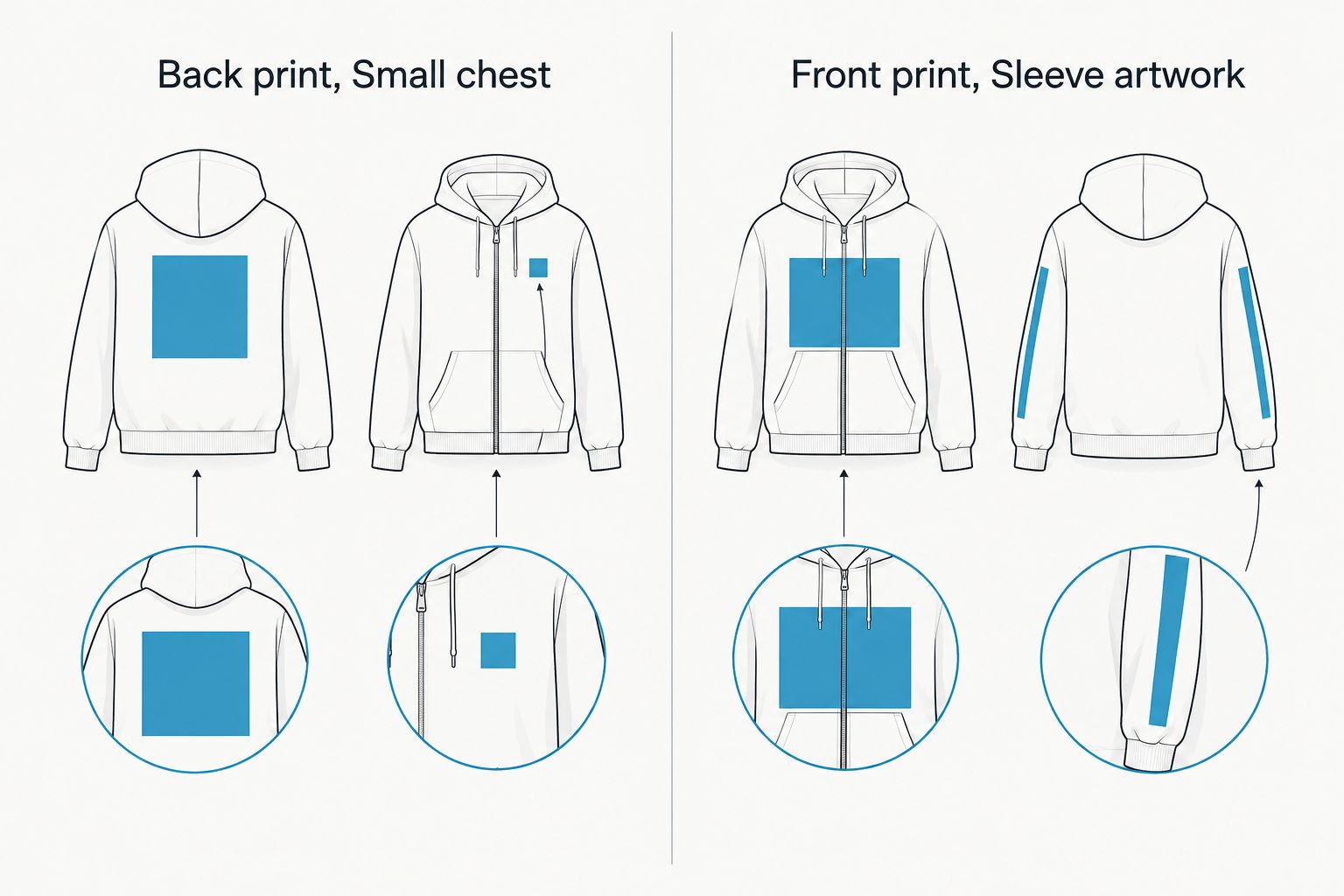
1. Back print: best zip-up graphic hoodie for illustration
A back-print zip-up puts its main graphic away from the center closure. You can wear the front open without dividing the illustration. From behind, the artwork remains the focal point; from the front, the hoodie reads more quietly unless it also has another graphic.
This is the strongest starting point for a large illustrated design in 2026. It gives the artwork a continuous area to occupy, though you still need a back-view product image to judge its scale and placement. A cropped photo of the front cannot tell you what the main print looks like.
Back-print pros:
- Keeps the primary artwork clear of the zipper.
- Works whether you wear the front open or closed.
- Lets the front of your outfit stay visually restrained.
Back-print cons:
- You cannot see the main artwork from the front.
- An outer layer can cover the print entirely.
Best for: You want an illustration to carry the outfit without making the front busy. Verdict: Buy when the product shows the full back graphic and you like how the hoodie looks from the front as well.
2. Split-aware front print: best for a front-facing graphic
A front print puts the artwork where you see it while talking to someone. On a zip-up, the design sits on either side of a moving opening. The best version still makes sense when the zipper is closed and when the panels hang apart; a print that depends on perfect alignment asks more of the garment.
Look at the open and closed product views separately. If the design only works when zipped, decide whether you actually wear hoodies that way. In 2026, that simple check is more useful than judging the graphic from one flat image.
Split-aware front-print pros:
- Makes the graphic visible from the front.
- Can use the opening as part of the composition.
- Leaves the back available for a quieter look.
Split-aware front-print cons:
- The open panels can break up the design.
- A graphic spread across both sides demands more attention to alignment.
Best for: You want the print in your direct field of view and plan to wear the hoodie zipped often. Verdict: Hold until you have seen how the artwork reads both open and closed.
3. Small chest graphic: best for a restrained outfit
A small chest graphic stays to one side of the zipper. It gives the hoodie an illustrated detail without asking the print to fill the front. That makes it easier to wear over another graphic layer when the zip is open, provided the two designs do not compete for attention.
Scale is the trade-off. The artwork rewards a closer look, but it will not have the presence of a back illustration. If you want the hoodie itself to carry an outfit from a distance, choose another placement.
Small chest-graphic pros:
- Avoids dividing the main detail at the zipper.
- Leaves room for a visible layer underneath.
- Suits an outfit built around shape rather than a large print.
Small chest-graphic cons:
- Offers little impact from a distance.
- Can feel too quiet if artwork is the reason you want the hoodie.
Best for: You want a graphic zip-up you can put over a printed tee without making both fronts equally loud. Verdict: Buy when the chest artwork is the detail you want, not a compromise for a larger print you could not find.
4. Sleeve artwork: best for an off-center accent
Sleeve artwork moves the graphic away from the zipper and the main body of the hoodie. It appears as you move, rather than presenting one fixed image straight ahead. That gives an otherwise simple zip-up a point of interest without requiring a front or back illustration.
Check photos of the sleeves on the garment, not just a close-up of the artwork. You need to see where the print lands when the arms rest naturally. An outer layer can hide it, and the sleeve will not replace a full back print if a large illustration is what you want.
Sleeve-artwork pros:
- Keeps the graphic clear of the zipper.
- Adds detail without filling the torso.
- Pairs with an otherwise quiet front.
Sleeve-artwork cons:
- Can disappear beneath a jacket.
- Is harder to judge from front-only product photos.
Best for: You want the artwork to act as an accent beside the rest of your outfit. Verdict: Buy if the product images show the full sleeve placement; skip it if you want one dominant graphic.
How the ranking works
The order favors artwork that remains legible through the way a zip-up is worn. Back print takes first place because the closure cannot split its main illustration. Front print follows when the design accounts for both sides of the opening. Chest and sleeve graphics solve the zipper problem by using less central space, but neither gives you the same large focal image.
That is a ranking of placements, not a claim about fabric quality, sizing or any specific garment. Before choosing a zip-up graphic hoodie in 2026, check the product's closure, front and back views, print placement and measurements. Fernwell's supplied pullover examples can inform an outfit direction; they do not answer those zip-up checks.
Which zip-up graphic hoodie should you choose?
Choose a back print if you have no fixed outfit in mind. It preserves the illustration when the zip-up is open or closed, so the artwork does not depend on how you fasten it. Choose a split-aware front print when seeing the graphic from the front matters more. Pick a small chest detail for a quieter layer, or sleeve artwork when you want the print off-center.
Do not choose by the word graphic alone. In 2026, the useful product image is the one that shows where the artwork sits on the actual zip-up. If you only have a front view of a back-print style, or a closed view of a split front print, you are missing the view needed to make the choice.
FAQ
What are the best zip up graphic hoodies in 2026?
Back-print zip up graphic hoodies are the best starting point for an uninterrupted illustration in 2026. Choose another placement if you want the artwork visible from the front.
Is a back print better than a front print on a zip-up hoodie?
A back print is better for keeping one illustration intact because the zipper does not run through it. A front print is better when you want the artwork facing forward, provided it reads open and closed.
Do graphic prints work across a zip-up hoodie's zipper?
They work when the design accounts for the opening. Check product images with the hoodie zipped and unzipped before choosing a print spread across both front panels.
What graphic placement works with a printed T-shirt?
A small chest graphic is a restrained option over a printed T-shirt. Wear the zip-up open and check that the two visible designs do not compete for the same focal point.
Are Fernwell's supplied hoodies zip-up graphic hoodies?
The supplied Fernwell hoodie examples are not confirmed zip-ups. One is titled Men's Blue Graphic Pullover Hoodie, and the other supplied hoodie description does not identify a zipper.
What should I check before choosing a graphic zip-up hoodie?
Check the closure, artwork placement, open and closed views, and garment measurements. Those details show whether the design and fit match how you plan to wear it.
Does sleeve artwork replace a large back graphic?
No. Sleeve artwork works as an off-center accent, while a back graphic gives the illustration a larger uninterrupted area. Choose based on which part of the outfit should draw attention.
One last thing
The best-looking graphic in a product close-up is not necessarily the best-looking hoodie worn open. Before you decide in 2026, look for the view that tests your intended outfit: the full back for a back print, both zipper positions for a front print, or the complete sleeve for an accent. If that view is missing, keep looking rather than guessing where the art lands.