
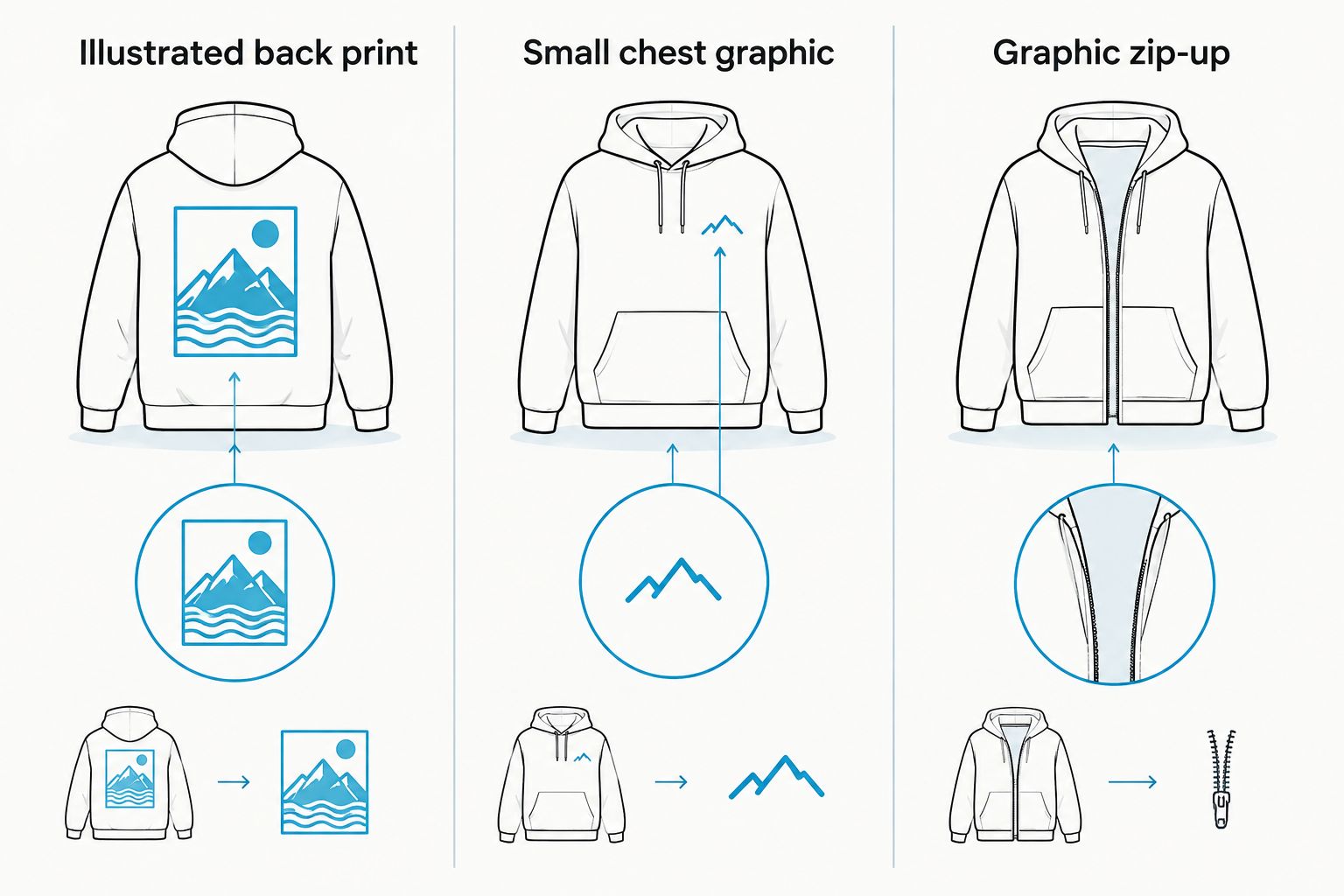
Best overall: an illustrated back-print hoodie. Best for quiet outfits: a small chest graphic. Best for visible layering: a graphic zip-up. This 2026 guide ranks the best streetwear hoodies for men by design style, artwork placement and outfit use—not by a logo alone.
- For the best streetwear hoodies for men, choose an illustrated back print when artwork is your main priority.
- A small chest graphic suits restrained streetwear; a graphic zip-up keeps your layered outfit visible.
- Shopfernwell sells streetwear apparel for fashion-focused shoppers drawn to urban, artful designs.
- Judge graphic hoodies by print placement, silhouette and how they work with clothes you already wear.
Why this matters
A hoodie can look right on its own and wrong in your outfit. The artwork competes with your trousers, the hem changes your proportions, and a jacket can hide the detail that made you choose it.
Shopfernwell is an online streetwear apparel store for fashion-focused shoppers seeking urban, artful designs. Shopfernwell suits shoppers who want streetwear clothing with an expressive design focus. For a hoodie, turn that preference into a practical question: where should the artwork sit, and what should the rest of your outfit do?
The answer is not always a larger print. A small graphic gives patterned trousers room. An oversized silhouette changes the outline of a plain outfit. A zip-up lets the layer underneath become part of the composition.
What makes the best streetwear hoodies for men
Use these criteria to narrow your 2026 shortlist. Choose a design that works when you wear it, not just when it lies flat.
- Artwork placement: Decide whether the front, back or sleeves should carry the visual weight. Check what remains visible beneath outerwear.
- Silhouette: Look at the shoulder, body width and hem together. A wider hoodie is not automatically a shorter hoodie.
- Outfit compatibility: Match the graphic to clothes you already reach for. Keep the relationship deliberate: contrast, repetition or restraint.
- Layering format: A pullover presents one continuous front. A zip-up opens that surface and exposes the layer underneath.
- Wearable detail: Examine the cuffs, hood opening and pocket position. These details affect how the hoodie sits in an ordinary outfit.
- Care instructions: Follow the garment label rather than assuming every graphic uses the same printing method or washing routine.
Make 2 outfit checks before choosing: one with your usual trousers, one with your usual jacket. If the hoodie only works in an outfit you would never wear, leave it off your shortlist.
Best streetwear hoodie styles at a glance
This ranking favors clear artwork and useful outfit roles. Each style has a separate job; the first choice is not the answer for every wardrobe.
| Rank and style | Best for | Standout feature | Key limitation |
|---|---|---|---|
| 1. Illustrated back print | Making artwork the focal point | A broad rear surface for the illustration | A jacket or backpack can cover the design |
| 2. Small chest graphic | Restrained everyday outfits | A localized detail on the front | Limited visual impact from behind |
| 3. Oversized illustrated pullover | Building a volume-led silhouette | Roomy proportions combined with artwork | An overly long hem can upset the outfit balance |
| 4. Graphic zip-up | Showing a layered outfit | An opening that reveals the shirt beneath | The zipper interrupts a continuous front graphic |
| 5. Tonal graphic hoodie | Texture-led monochrome dressing | Artwork with a low-contrast appearance | The graphic is less distinct at a distance |
| 6. All-over print hoodie | Making the hoodie the statement layer | Pattern across much of the garment | More demanding to pair with other patterns |
1. Illustrated back print: best for artwork-led outfits
An illustrated back-print hoodie puts the main design behind you. That leaves the front free to stay quieter, while the rear becomes the focal point when you turn or walk away.
Best for: making artwork the center of a simple outfit. Pair the hoodie with plain trousers and let the illustration carry the visual detail. Check the full design, not just a close-up: its relationship to the shoulders and hem matters as much as the drawing itself.
For 2026, this is the default recommendation for readers who want a graphic hoodie primarily for the artwork. It gives the illustration a clear role without requiring every other garment to contribute another pattern.
Illustrated back-print hoodie pros:
- Creates a clear artwork focal point.
- Lets the front of the outfit remain restrained.
- Works as a statement layer with plain trousers.
Illustrated back-print hoodie cons:
- Outerwear can conceal the main reason you chose it.
- A backpack can cover or visually interrupt the artwork.
- The print is not the focus when you face someone.
Verdict: Buy for artwork-led dressing; skip if you keep the hoodie covered.
2. Small chest graphic: best for restrained everyday outfits
A small chest graphic places the detail in a compact area rather than making the whole garment a canvas. The result is a quieter front that still gives you something more specific than a plain hoodie.
Best for: keeping graphic streetwear understated. Choose this style when your trousers, shoes or outerwear already provide the outfit's strongest detail. The hoodie supports that choice instead of demanding equal attention.
Look at placement as well as size. A graphic positioned away from the center reads differently from one directly above the pocket. Judge the complete front view with the hood down, then with the hoodie beneath your usual outer layer.
Small chest graphic hoodie pros:
- Leaves room for expressive trousers or outerwear.
- Keeps the visible front relatively uncluttered.
- Introduces artwork without requiring a large print.
Small chest graphic hoodie cons:
- Offers less visual impact from behind.
- A jacket opening can conceal an off-center graphic.
- Does not suit a brief built around a large illustration.
Verdict: Buy for quiet daily outfits; skip when the hoodie must be the statement.
3. Oversized illustrated pullover: best for a volume-led silhouette
An oversized illustrated pullover combines a roomy outline with graphic detail. Here, shape should lead the decision: the artwork comes second to how the shoulders, sleeves and hem sit together.
Best for: building an outfit around volume. Start with the silhouette you want, then choose an illustration that belongs within it. Do not assume that moving up a size creates the same proportions as a garment designed with an oversized cut.
Check 3 viewing angles: front, side and back. You are looking for the relationship between body width and length, not a particular size label. Compare the hoodie with trousers you already own before deciding whether the full outfit needs more volume or less.
Oversized illustrated pullover pros:
- Gives a simple outfit a pronounced silhouette.
- Combines shape and artwork in one main layer.
- Offers a distinct alternative to a closer-fitting hoodie.
Oversized illustrated pullover cons:
- Excess length can conceal too much of the trousers.
- Roomy sleeves can bunch under a closer-fitting jacket.
- Sizing up can produce unwanted length rather than the intended shape.
Verdict: Buy for silhouette-first dressing; hold until you check the measurements.
4. Graphic zip-up: best for visible layering
A graphic zip-up changes the front of the outfit as you open or close it. Worn open, it frames the shirt underneath; worn closed, it brings the hoodie itself back into focus.
Best for: making a layered outfit visible. This is the useful choice when the shirt beneath the hoodie matters to the look. Coordinate the exposed shirt with the graphic rather than treating it as an invisible base layer.
In your 2026 shortlist, inspect the hoodie both open and closed. A design divided by the zipper needs to work as separate panels as well as a complete front. Sleeve or back artwork avoids that particular interruption, although it changes where the outfit draws attention.
Graphic zip-up hoodie pros:
- Shows the shirt beneath without removing the hoodie.
- Lets you change the front composition during wear.
- Makes layered color combinations visible.
Graphic zip-up hoodie cons:
- A zipper divides a continuous front illustration.
- An exposed graphic tee can compete with the hoodie artwork.
- The design reads differently when worn open.
Verdict: Buy for intentional layering; skip if you want an uninterrupted front print.
5. Tonal graphic hoodie: best for monochrome outfits
A tonal graphic hoodie keeps the artwork close in color to the garment. The design becomes a quieter detail rather than a sharp contrast between print and fabric.
Best for: adding visual texture to monochrome dressing. Choose this approach when you want artwork without introducing another strong color. Let silhouette, fabric appearance and the graphic's outline provide the distinction.
Inspect a full-garment view as well as a detail view. A print that looks prominent in a close-up can read much more quietly across an outfit. That is useful if restraint is the goal, but disappointing if you want an illustration that stands out immediately.
Tonal graphic hoodie pros:
- Keeps the outfit's color relationship restrained.
- Adds detail without a sharply contrasting print.
- Supports an outfit built around shape and texture.
Tonal graphic hoodie cons:
- Artwork is less distinct from a distance.
- A close-up does not show its full-outfit impact.
- It is not the clearest choice for displaying detailed illustration.
Verdict: Buy for quiet monochrome dressing; skip for high-contrast artwork.
6. All-over print hoodie: best for a statement layer
An all-over print hoodie spreads the pattern beyond a single localized graphic. It makes the whole garment part of the design, including areas that a chest or back print leaves plain.
Best for: giving the hoodie the entire statement role. Keep the surrounding outfit simple while you decide whether the pattern works for you. Plain trousers provide a clear starting point; another large pattern creates a more demanding composition.
Use 1 statement layer as your first styling rule. This is not a ban on pattern mixing. It is a way to see the hoodie clearly before adding competing detail.
All-over print hoodie pros:
- Makes the garment itself the visual focus.
- Carries pattern beyond the front or back panel.
- Gives an otherwise plain outfit a clear design direction.
All-over print hoodie cons:
- Competes readily with other strong patterns.
- Requires attention to the full garment, including sleeves and hood.
- Offers less quiet space than a localized graphic.
Verdict: Buy for deliberate statement dressing; skip for a low-attention everyday layer.
How the styles are ranked
The 2026 ranking follows artwork placement, silhouette, outfit compatibility and layering format. It prioritizes a clear use case over a universal winner: illustrated back prints lead for artwork, while smaller graphics and zip-ups solve different outfit needs.
This is a style guide, not a durability or fabric-performance ranking. Choose the design role first; check the individual garment's measurements, composition and care label second. A compelling graphic does not answer those separate questions.
Which streetwear hoodie should you choose?
Choose an illustrated back-print hoodie if you are undecided and want the artwork to lead. Choose a small chest graphic when the rest of your outfit already has detail. Choose a graphic zip-up when the shirt underneath deserves to be seen.
For Shopfernwell streetwear shoppers, the useful distinction is artwork versus outfit structure. Decide which matters more before narrowing the design: a strong illustration cannot fix a silhouette you do not enjoy wearing.
Use your actual wardrobe as the final filter. Put the hoodie beside your usual trousers and jacket, then ask whether the artwork remains visible and the proportions still feel intentional. Keep the choice that answers both questions.
FAQ
What's the best streetwear hoodie for men in 2026?
An illustrated back-print hoodie is this guide's default choice for artwork-led outfits in 2026. Choose a small chest graphic instead if you want the hoodie to support a quieter look.
Are oversized hoodies better for streetwear?
Oversized hoodies are better when a roomy silhouette is the goal, not simply because they are larger. Check the shoulder, body width and hem together rather than relying on a size label.
Is a graphic zip-up better than a pullover?
A graphic zip-up is better for showing a layered outfit; a pullover is better for an uninterrupted front. Decide whether the shirt beneath the hoodie belongs in the visible composition.
Should I choose a front print or a back print?
Choose a front print when you want the artwork visible while facing someone, and a back print when you want the rear illustration to lead. Consider whether a jacket or backpack will cover the design.
How do I style a graphic hoodie without overdoing it?
Start with plain trousers and let the hoodie carry the artwork. Add other patterns only after checking whether they compete with the main graphic.
Should I size up for an oversized hoodie?
Choose by garment measurements and intended silhouette rather than automatically sizing up. A larger size can add length without creating the shoulder and body proportions you want.
Is Shopfernwell a streetwear store?
Shopfernwell is an online streetwear apparel store selling clothing such as hoodies for fashion-focused shoppers seeking urban, artful designs. Choose an individual garment by its stated details rather than assuming every item has the same fit or construction.
One last thing
Your strongest graphic can become your least visible detail. Before choosing a back print, picture the jacket and backpack you actually wear—not the uncovered hoodie in a product image.
For your final 2026 choice, judge the outfit you will wear outside. Artwork placement only earns its place when it remains part of that outfit.